Tools for Educators
This space offers conceptual and pedagogical tools for educators emerging from our collaborative research and partnership over the last few years. The tools are designed to foster students’ deep and powerful learning while exploring complex societal challenges, such as climate and environmental issues.
We work toward a vision of education that supports young people’s holistic growth as transformative agents who not only critically and deeply understand themselves and the world around them, but also act for living together in a just, multicultural, sustainable and democratic society. Education should provide opportunities for young people to explore who we are and how we come to be here-and-now while grappling with complex global and societal challenges in contexts. We work with educators to foster student agency, critical thinking, and collective caring through place-based,community-centered teaching and learning.
Teaching for JuST framework
What:
Instructional framework for guiding the design of learning activities with the goal of creating a just, sustainable and thriving community.
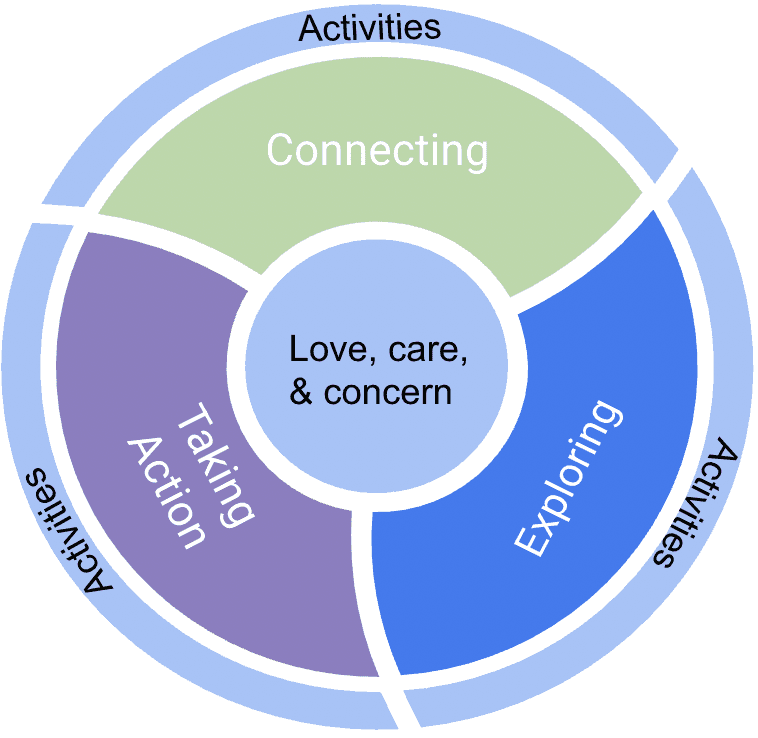
The Framework anchors learning in students’ love, care, and concern. Teachers first facilitate students to make meaningful connections with people, community, and the world at the beginning of the unit. In the middle of the unit, students are guided to explore focal issues by leveraging both disciplinary and students’ cultural knowledge and practices. Toward the end of the unit, students take actions to address issues they are passionate about. This framework helps teachers to achieve two learning goals. One is to build and expand students’ reciprocal and ethical relationships with people from non-dominant communities, more-than-humans, and the Earth. The other is to increase students’ critical agency to take actions to create a more just community with holistic connection with the land. Science and engineering knowledge and practices are mobilized for students’ making of the world.
Why:
Theoretically, the Teaching for JuST framework builds upon decades of research on learning. The contemporary learning theory (NASEM, 2018, Nasir et al., 2021) helps us to broaden the concept of learning as “who one is becoming” beyond “what one knows and can do.” With the premise that learning is fundamentally cultural, this theory highlights the deep and intricate connections between cognition and emotion, mind and body, learning and identities, development and places. In addition, this framework reflects deliberate efforts to embrace heterogeneity in our ways of knowing, talking and being by integrating indigenous pedagogy, epistemology and worldviews (Bang et al., 2018; Marin & Bang, 2018). The framework centers relationality, responsibility and reciprocity in the process of designing learning environments.
Credit:
This tool was developed by Hosun Kang to support teachers’ co-design of transdisciplinary, justice-centered unit as part of the NSF funded project (DRL #1846227)
link to top
Pedagogical Tools
click + on each card to learn more
03
Civic Action Matrix
07
Climate Stories

Worrying and Happy Emotion Boards (Kang, Tsai, & Voragen, in preparation)
What:
A pedagogical tool that supports teachers to elicit and mobilize students’ emotions towards collective civic action.
Why:
Youth experience a mix of emotions when learning about the climate crisis, ranging from anxiety, grief, anger, or even hopelessness. To support students’ deep thinking and action, the teacher should attune to and document students’ emerging emotions throughout the unit. This tool supports teachers to acknowledge, validate, and cluster students’ feelings while providing a space for students to process their emotions. Integrating emotional reflection into climate learning helps students make meaning of complex issues, fosters critical hope, and encourages collective action rooted in care and justice.
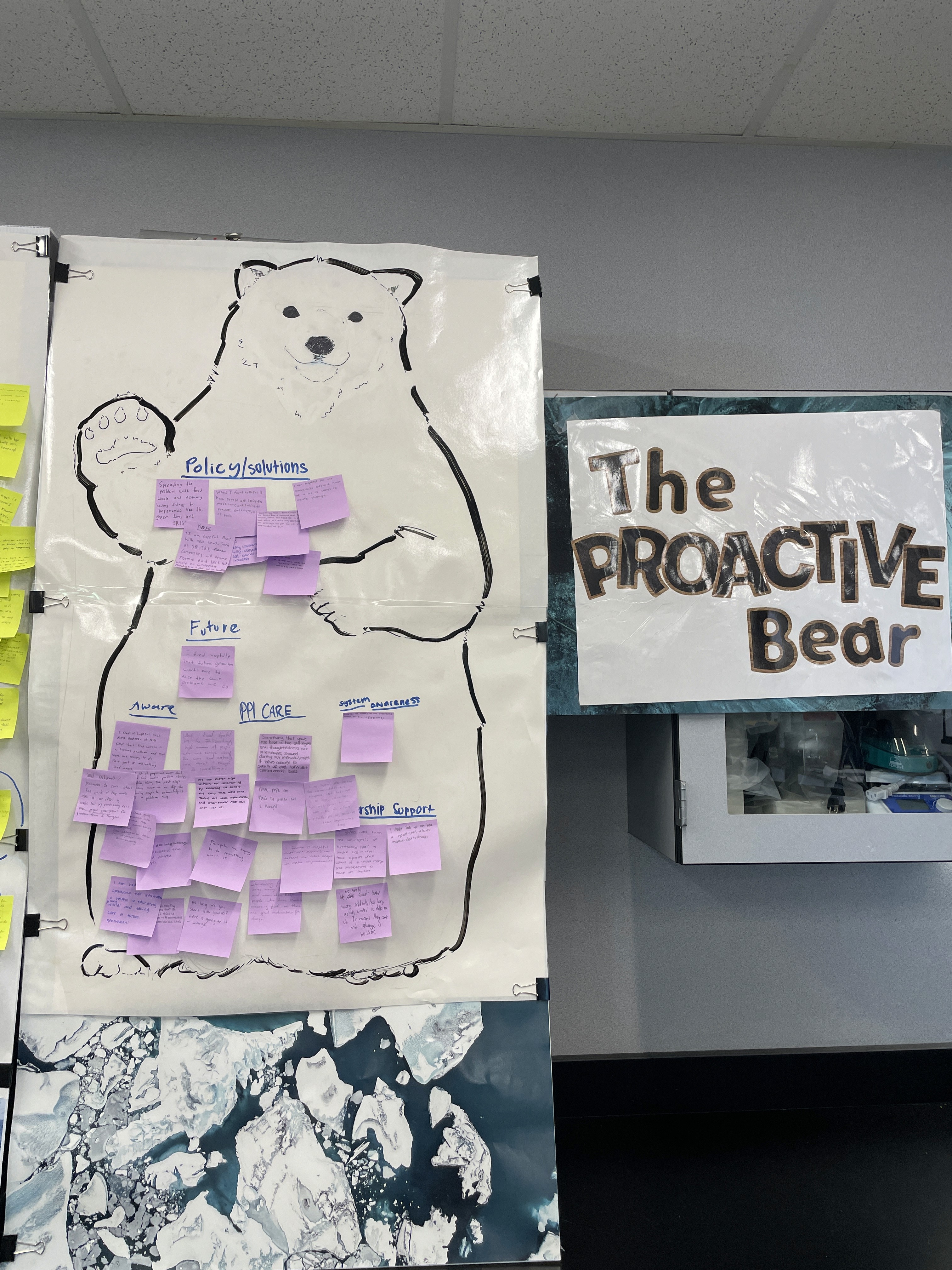
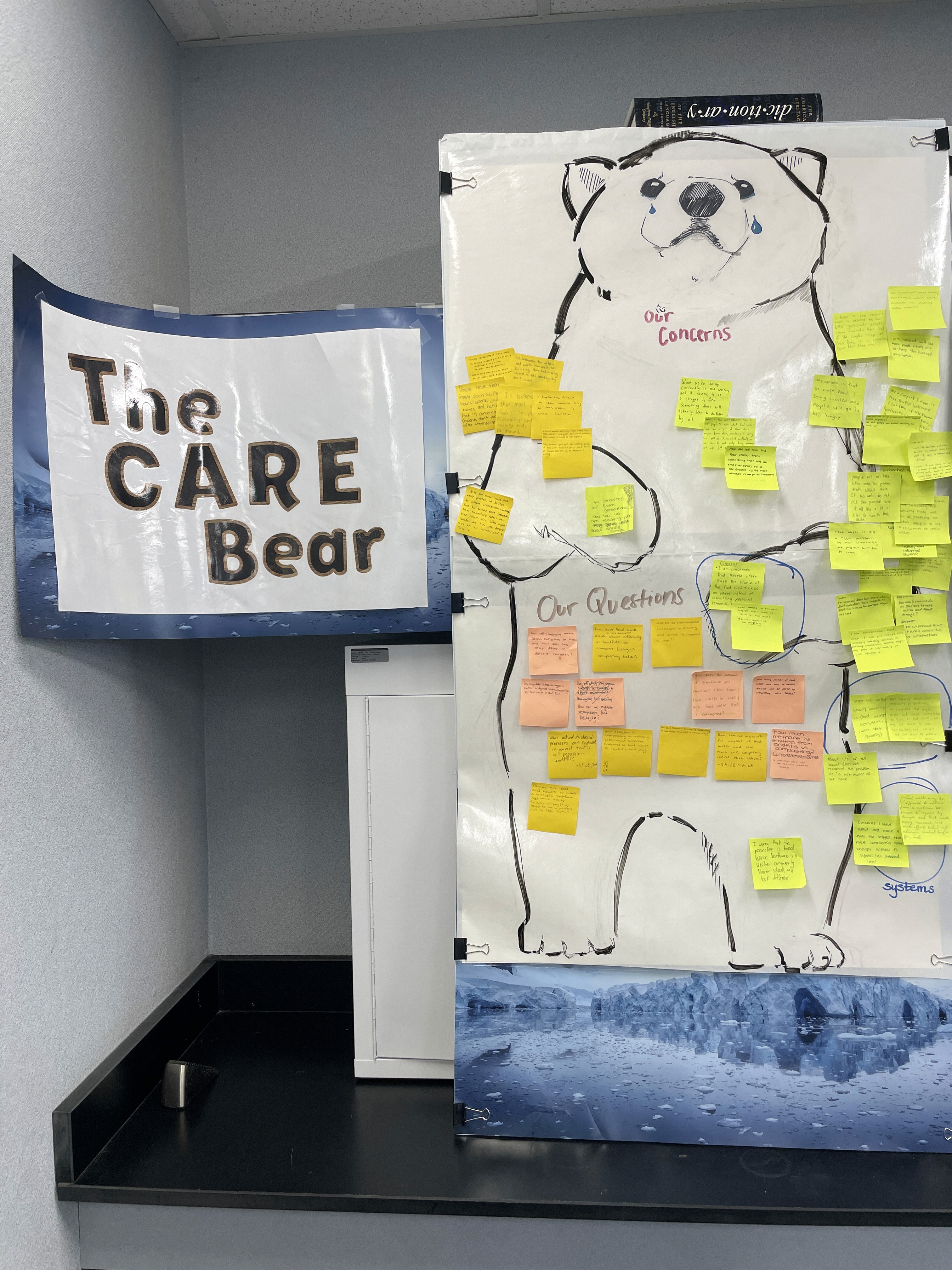
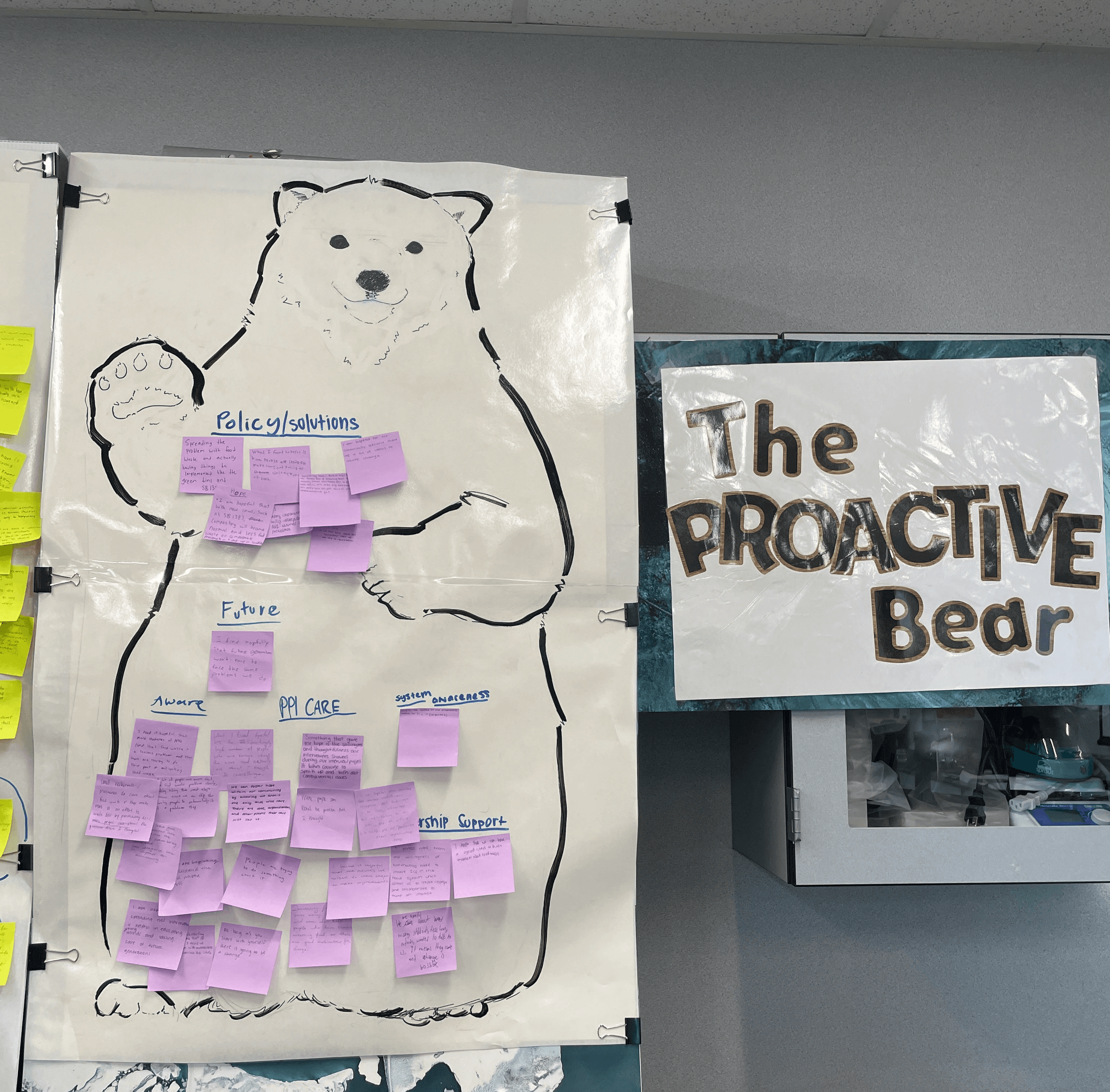
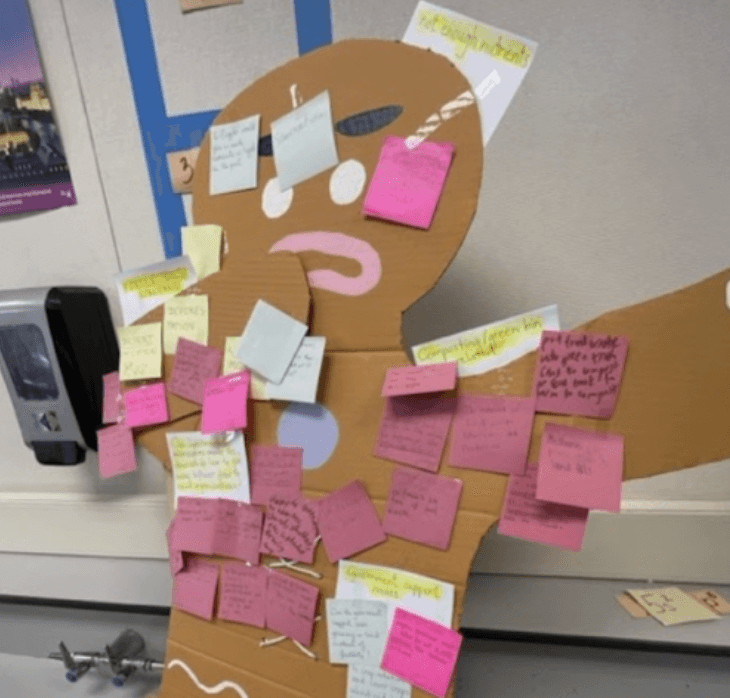
The Emotions Boards create a space for students to publicly share their feelings as they learn about the climate crisis. The boards can take fun or meaningful shapes, such as school mascots, favorite class animals, or impacted ecosystems. There are two parts of the Emotion Boards:
The Worrying Board - Students express concerns, anger, or frustrations about the focal issue.
The Happy Board - students share hopeful stories, solutions, or positive interactions, or moments of meaningful connections with community members.
Throughout the unit, students add notes to these boards as they explore various aspects of focal problem. The notes are organized into themes, which can inspire and shape their civic action project that is “on their hearts”.
Credits: This tool was originally developed by Mrs. Kata Voragen at Magnolia High School who participated in the NSF project (DRL #1846227)
link to top
Civic Action Matrix: (Lieu, Tsai, Yett, & Kang, 2025)
What:
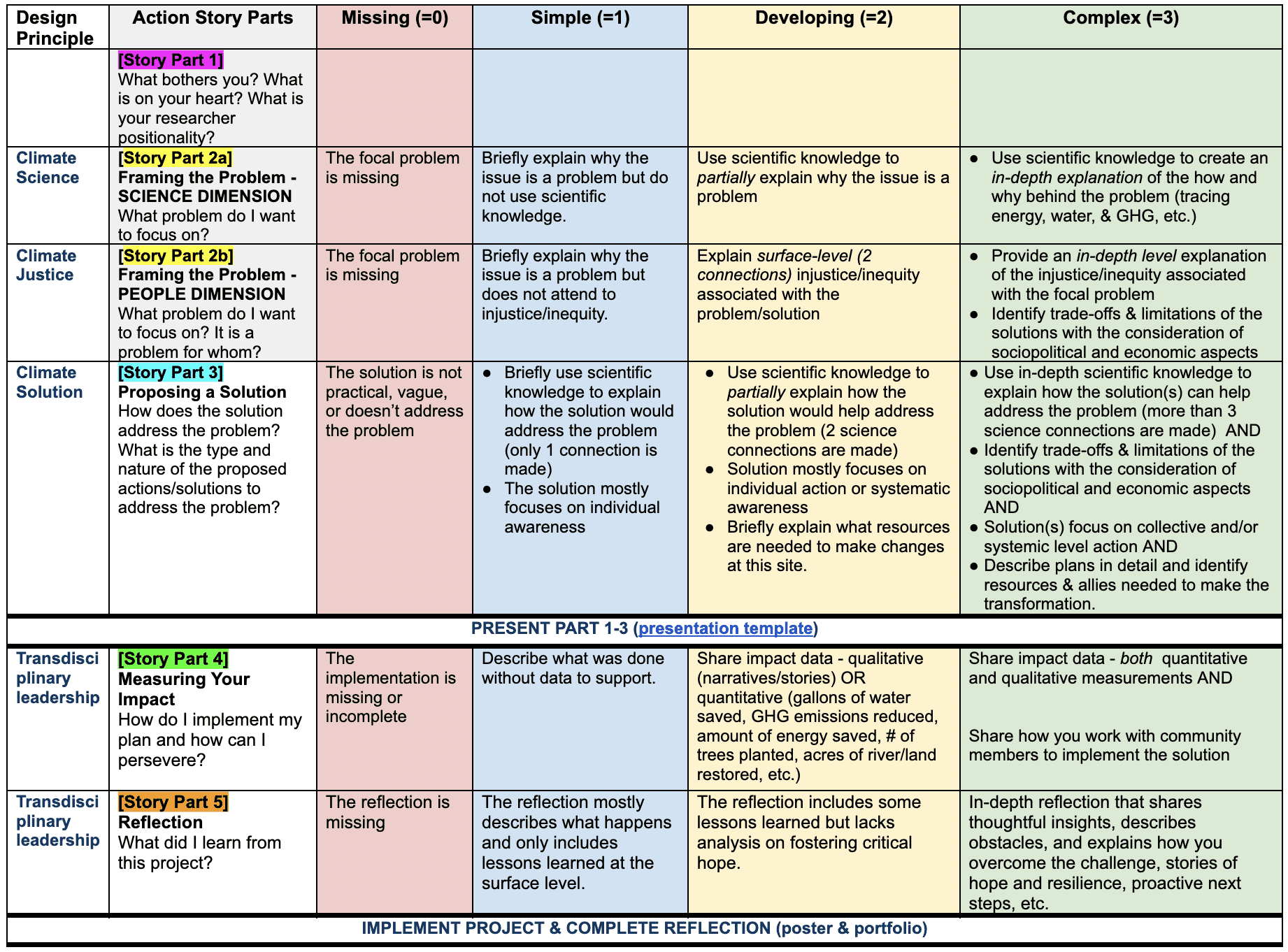
A pedagogical tool that supports teachers to facilitate civic engagement and help students design and enact justice-centered climate solutions.
Why:
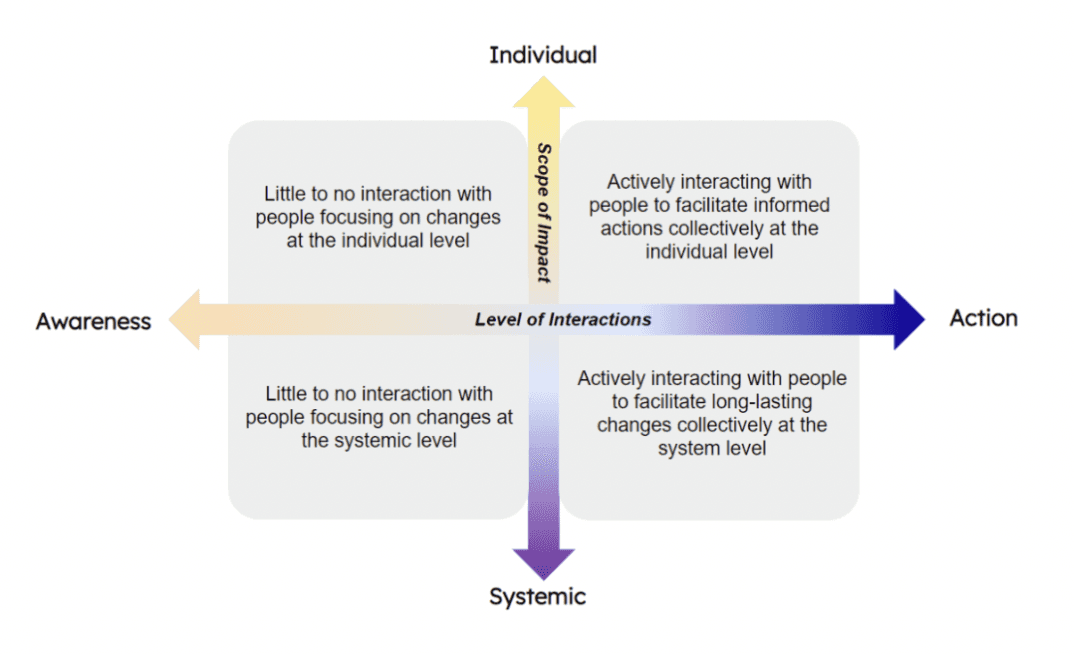
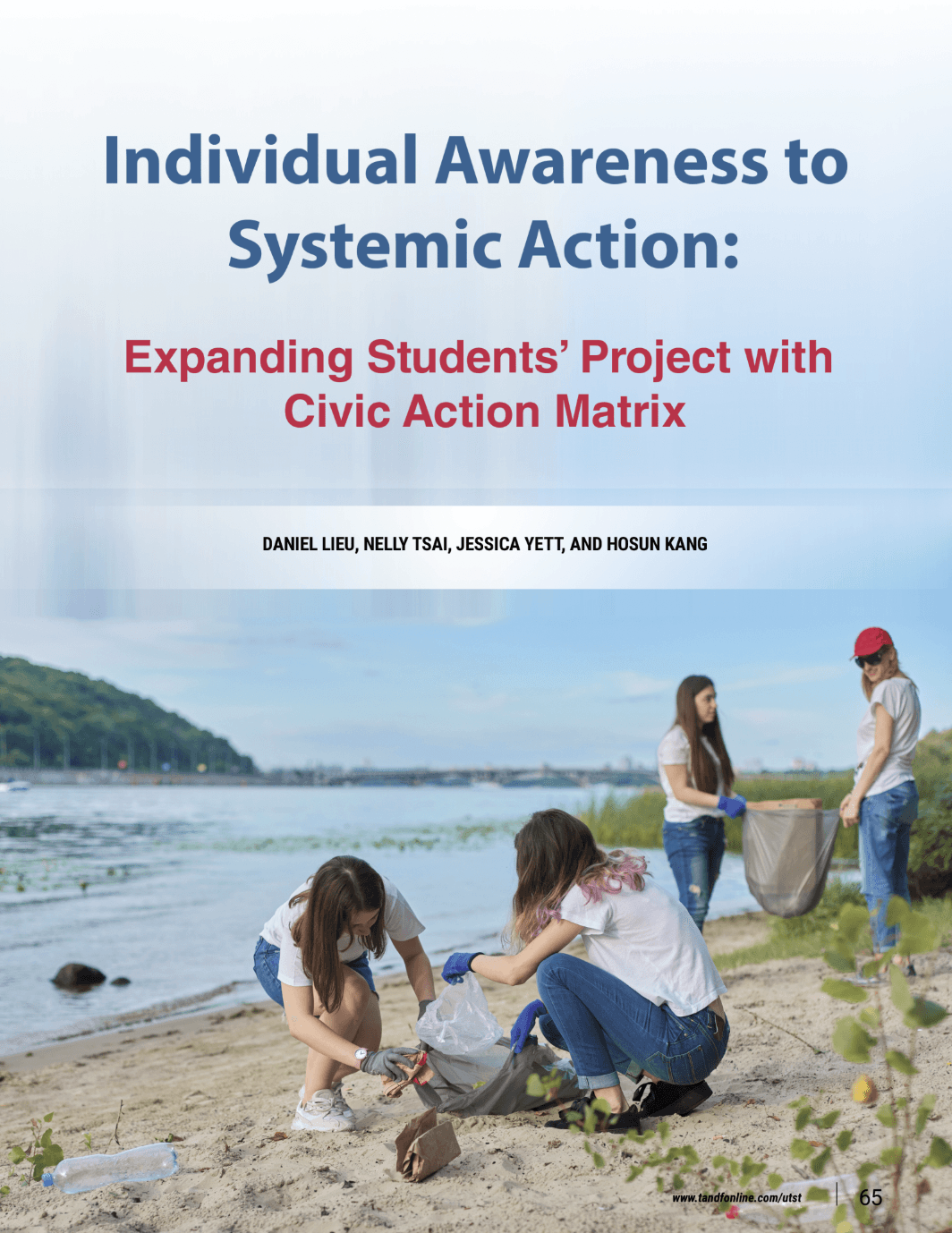
The urgency of the climate crisis demands collective and systemic actions to mitigate the crisis. The Civic Action Matrix provides a conceptual framework for teachers and students to reflect on the type and nature of civic actions they take, ranging from individual awareness to systemic actions. The tool can enhance students’ civic action projects in a way that promotes a sustainable systemic change through collective actions. See the details in the NSTA article, Individual Awareness to Systemic Action: Expanding Students’ Project with Civic Action Matrix for more information by Lieu, Tsai, Yett and Kang (2025).
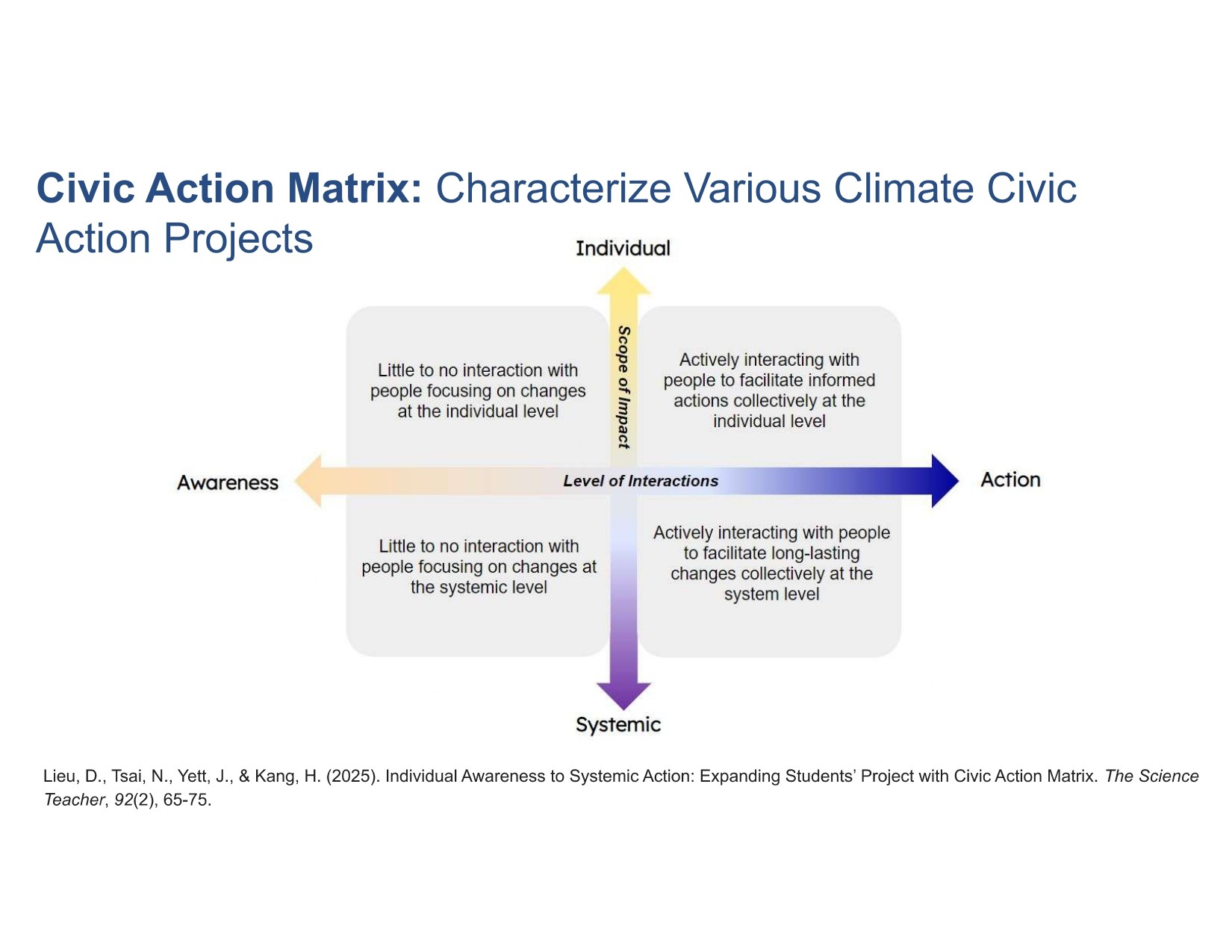
The Civic Action Matrix maps student actions along two dimensions: the horizontal axis shows the level of interaction with others (ranging from low interaction on the awareness side to high interaction on the action side), and the vertical axis indicates the impact level (from individual behavior change to systemic change).
Credit: This tool was generated from teacher researcher activities led by Daniel Lieu, Nelly Tsai, and Hosun Kang as part of the NSF funded project (DRL #1846227)
link to top
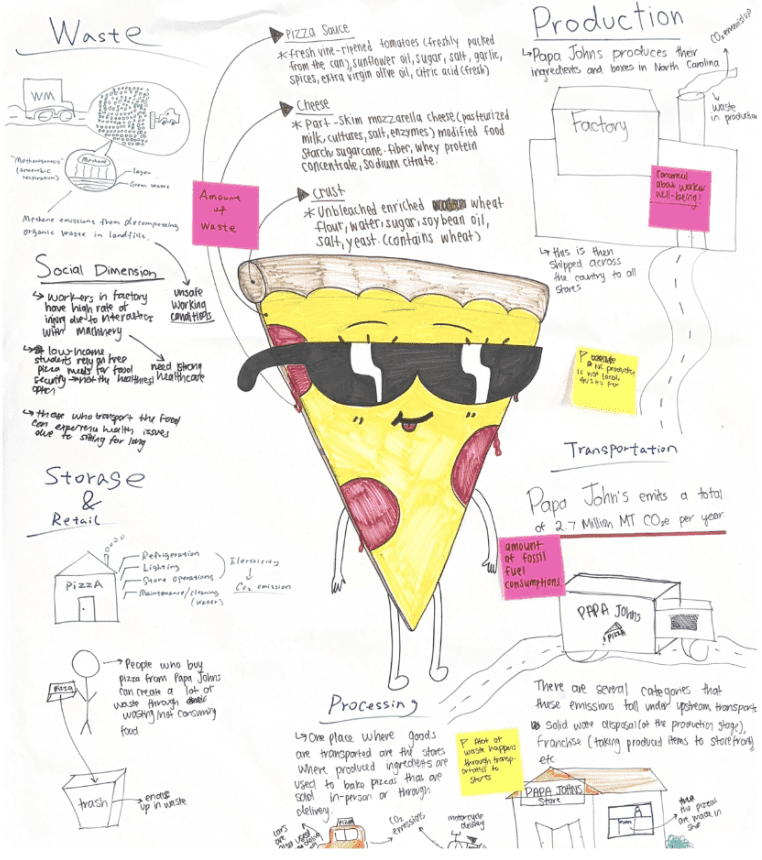
Food/Plastic/Clothes System Tracker
What:
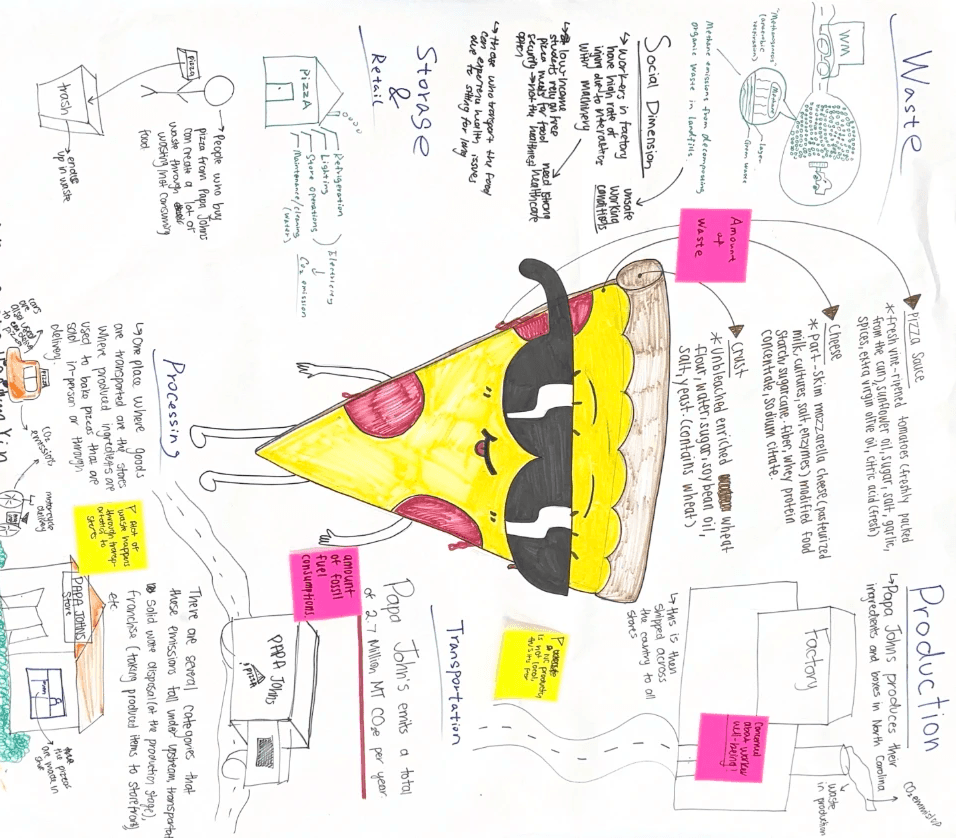
This tool helps students develop system level thinking by tracing the lifecycle of a product and examining its environmental and social impacts.
Why:
To better conceptualize climate change-related phenomena, students need to engage in system level thinking to understand the complexity of the problem. The system tracker guides students to identify various components of the system, cause-and-effect relationships, and the scale of impact. This process helps students reflect on linear vs. circular economy, connect the system-level problems to choices we make as consumers, and identify points of intervention to enact changes.
How to use:
Students select a product (their favorite food, plastic product, a piece of clothing they wear, etc.) and trace its path through production, transportation, preparation, consumption, and disposal. They first analyze the science dimension by tracing the amount of greenhouse gas emission, water consumption, and energy usage at each stage. Then they examine the social dimension by critically thinking who is most harmed, who holds responsibility, and how power and inequities shape the system.
Sample project: Living Map; Trace an Item
Who:
This tool was developed by Hosun Kang and Maria Simani as part of developing the food waste unit in collaboration with Climate Change Collaboratives.
link to top
Mapping Community Concerns
What:
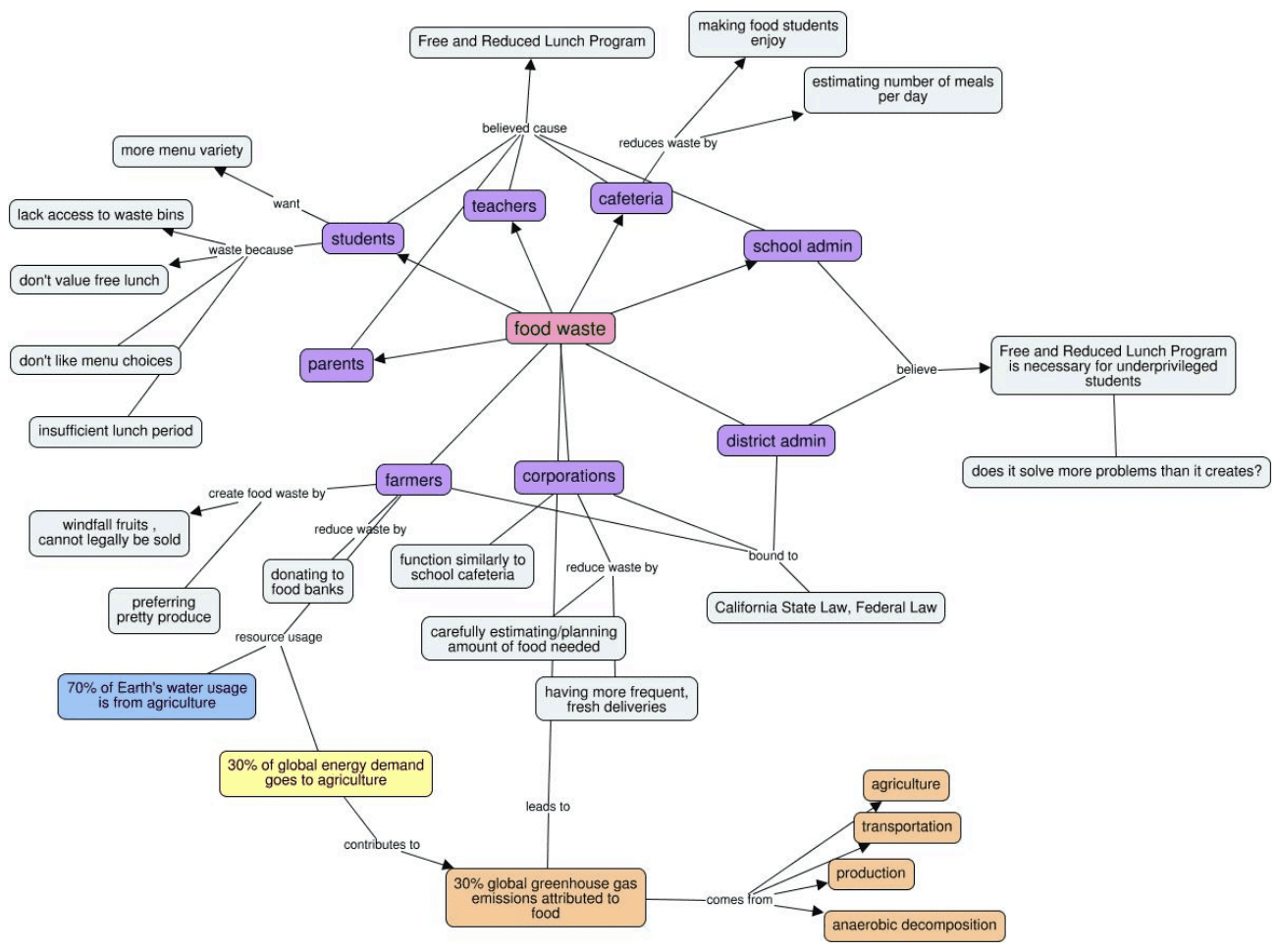
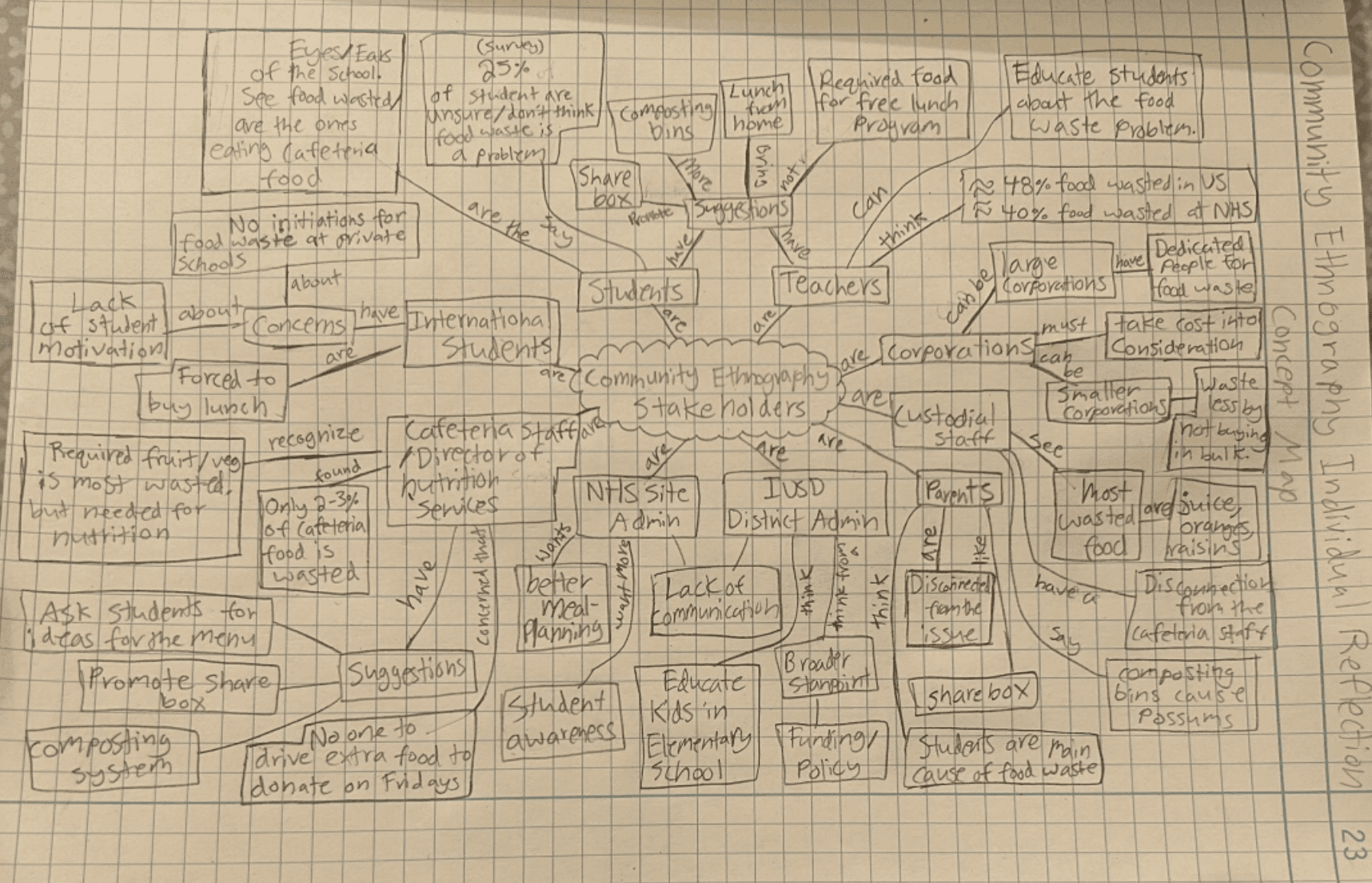
This tool supports students to interact with people in their community, mapping out various community’s concerns around a local issue, such as cafeteria waste or school traffic. They take on the role of community scientists to explore lived experiences and expand their perspectives
Why:
One of the central learning experiences in climate justice education is connecting with those directly impacted by the issue. Through storytelling and interacting with members in the community, students develop empathy and a complex, systems-level understanding of climate-related problems while identifying ways to enact local solutions. This supports climate justice education by grounding learning in community voices and lived experiences.
How to use:
Students first identify various community members that are impacted by the issue (parents, teachers, students, admin, support staff such as custodians or cafeteria workers, city representatives, etc.). In small groups, they design research tools, such as interviews, surveys, or observations, to gather different perspectives. They analyze the data to identify key themes and community concerns.
Credit:
This tool was inspired by Angela Calabrese Barton and Edna Tan’s Community Ethnography activity.
Tan, E., & Barton, A. C. (2017, October). Designing for rightful presence in STEM-rich making: Community ethnography as pedagogy. In Proceedings of the 7th Annual Conference on Creativity and Fabrication in Education (pp. 1-8). https://repository.isls.org/handle/1/919
link to top
Food Waste Curriculum
What:
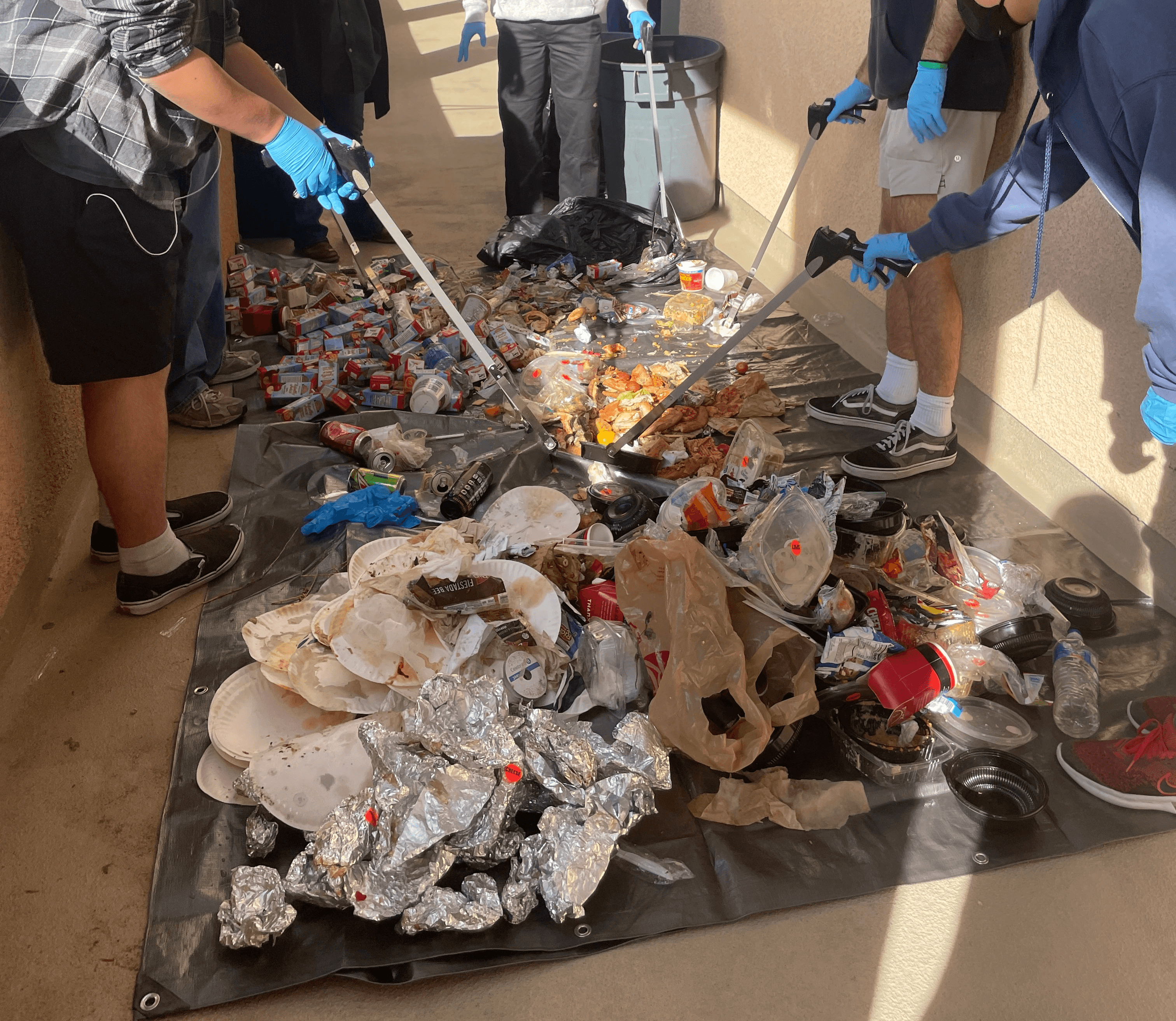
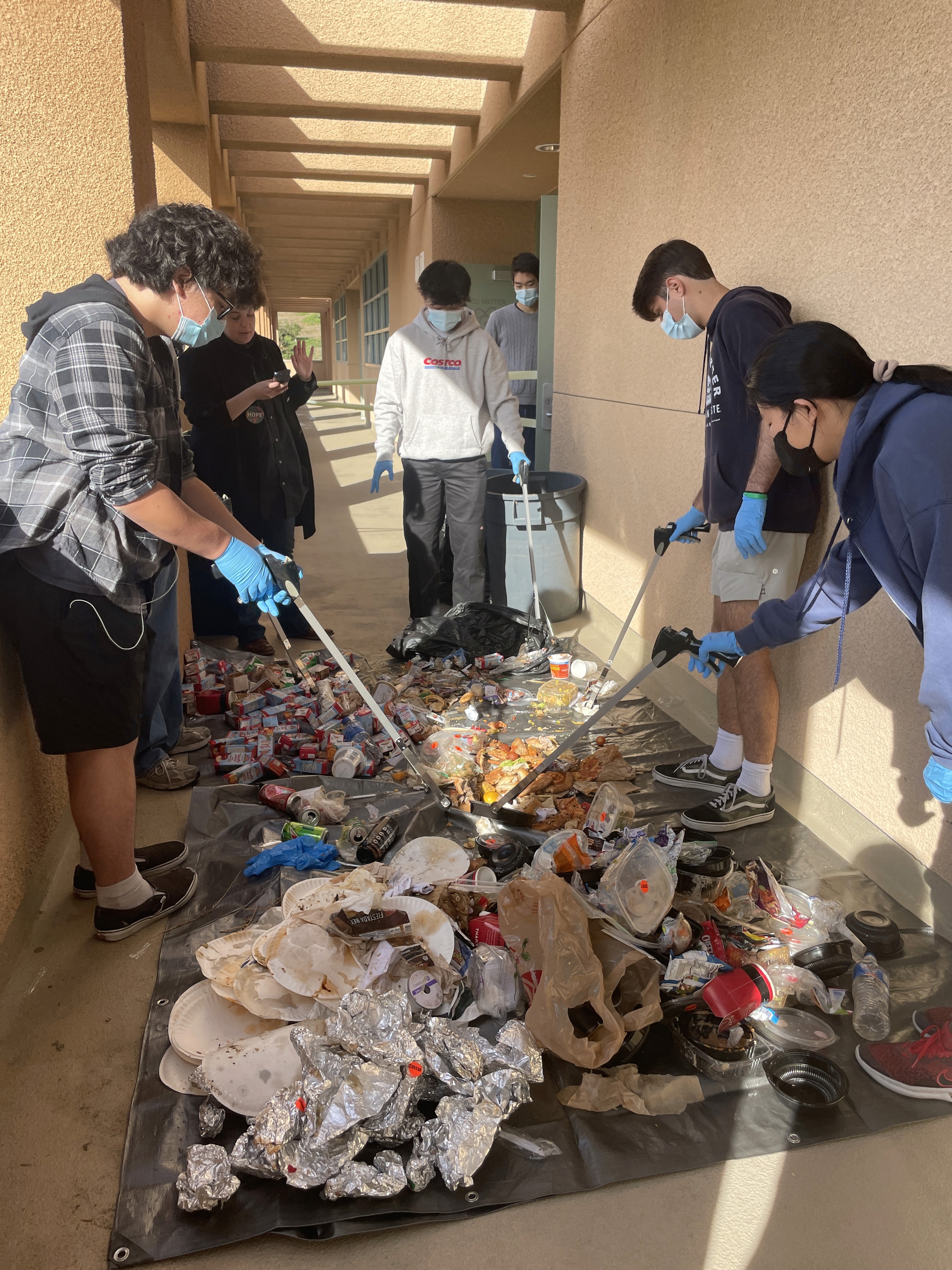
Using school lunch as a site of inquiry, students explore how reducing food waste as school can help address the climate crisis.
Why:
This is a sample model unit that illustrates the Teaching for JuST framework and how students can engage in meaningful climate actions. This model unit provides a concrete image of a transdisciplinary, justice-oriented teaching. Educators are encouraged to use the framework to adapt the unit in local contexts.
Who:
The curriculum materials were developed by Hosun Kang, Nelly Tsai, Nicole Midani, and Maria Simani in the process of developing a model unit for climate change education. The unit storyline is the outcome of the Climate Change Collaborative activities–a group of science education researchers at UC Irvine, UC Santa Barbara, UC Riverside, University of Washington, and teachers at Irvine Unified School District. Please contact Nelly Tsai (nelly.tsai@uci.edu) or Hosun Kang (hosunk@uci.edu) if you would like to use these materials.
Food System Unit Storyline
link to top
My Climate Stories
What:
This tool supports students’ storytelling related to the unit’s focal issue (e.g., My Food Stories, My Plastic Stories)
Why:
This activity supports the Connecting phase of the JuST framework by facilitating students to form personal and cultural connections to the focal issue. The storytelling also fosters students to make connections with people, including peers and the teacher, from different cultural backgrounds. By drawing on their lived experiences and cultural practices, this activity facilitates students’ emotional, interpersonal and conceptual engagement.
How to use:
In the Food System unit, students share a meal that has a special meaning to them. They use images that represent the meal, the feelings that this meal brings up, and who they share this meal with. The item can be replaced with the focal problem of the unit such as clothes, plastic, land, etc. Students can present their stories through collages, artwork, slideshows, or any creative format that reflects their identities.
Who:
This tool was developed by Nelly Tsai & Nicole.
link to top

This work is licensed under a Creative Commons Attribution 4.0 License CC BY-NC 4.0
2024-Present
